The Early Internet
1991 – 2004
The World Wide Web became publicly available on August 6, 1991. It described the web itself: what it was, how to use it, how to set up a server. The audience was researchers. No one anticipated that within a decade it would be the dominant medium for communication, commerce, and culture.
This exhibit covers the consumer internet from the Mosaic browser in 1993 through the broadband transition of the early 2000s, told through three artifacts that each represent a different mechanism of adoption.
Key Objects
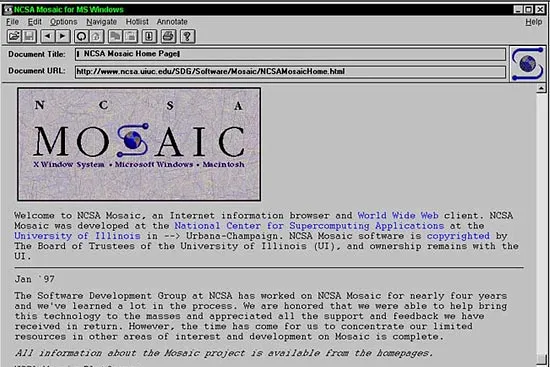
NCSA Mosaic Browser
The first web browser to display inline images alongside text, making the World Wide Web visually accessible to general users and triggering the first wave of mainstream internet adoption.
Curatorial Note
Before Mosaic, the web was text. Mosaic made it a medium. The team that built it — including Marc Andreessen, who later co-founded Netscape — were graduate students. The browser that started the commercial internet was built by people who were not yet in the industry it would create.
AOL Dial-Up Service
Introduced email, instant messaging, and online communities to mainstream American households through a mass CD distribution campaign.
Curatorial Note
AOL mailed over one billion CDs to American households between 1993 and 2006. At its peak in 2002, AOL had 35 million subscribers. We include AOL not as a technological achievement but as a distribution achievement: it is the reason most Americans' first experience of the internet was through a walled garden rather than the open web.
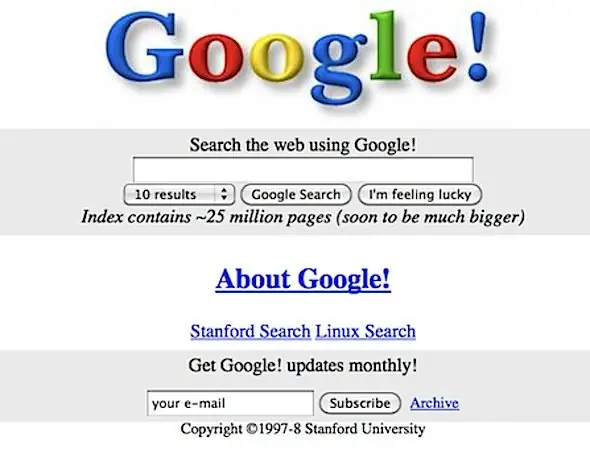
Google Search
Replaced directory-based web navigation with algorithmic search, fundamentally changing how people find information and establishing the advertising-supported search model.
Curatorial Note
Larry Page and Sergey Brin's original paper on PageRank noted that advertising-supported search engines were inherently biased toward advertisers over users. Google's historical significance is that it solved information retrieval well enough to make the web's scale an asset rather than a liability.
From Novelty to Infrastructure
In 1995, approximately 16 million people worldwide used the internet. By 2000, that number had grown to 361 million — a 22-fold increase in five years, faster than any previous communication technology (Internet World Stats).
The early internet normalized asynchronous communication. Email made it possible to communicate across time zones without scheduling, to compose thoughts carefully rather than speaking spontaneously, and to maintain relationships at low cost across large distances.
The broadband transition between 2000 and 2004 changed not just speed but behavior. Always-on internet access made the web ambient rather than intentional. The shift from going online to being online marks the boundary between the early internet and everything that followed.
Sources & Further Reading
The following institutional sources were used in the preparation of this exhibit.
- Computer History MuseumInternet History
- BritannicaInternet: History and Development